IT Professional. Data nerd. Photography enthusiast. Wife and mother. Weight Watcher. Atheist. Owner of many flowerbeds.
491 stories
·
3 followers

Study: Authoritative Parenting Less Common in ADHD Families

1 Comment

June 18, 2026

An authoritative, consistent, and noncoercive parenting style is the most effective for children with ADHD. However, a recent meta-analysis published in Child & Adolescent Psychiatry found that parents of neurodiverse children are more likely to use negative parenting practices.1

According to the study, parents of children with ADHD displayed higher levels of hostility, inconsistent discipline, family conflict, and abuse. They were less likely than parents of neurotypical children to exhibit warmth, expressive encouragement, and structure.

Parents of children with ADHD were also more likely to practice authoritarian parenting, which emphasizes obedience through harsh discipline and strict rule enforcement.

“Authoritarian parenting and its techniques, we now know, can cause distress and are linked to maladaptive behaviors,” said Caroline Mendel, Psy.D., in the ADDitude webinar “Parenting Styles That Work for Neurodivergent Children.”  “Children, especially neurodivergent children, do not respond well to this form of parenting.

“On the other hand, permissive parenting, characterized by high levels of warmth and little to no limit setting, isn’t what our children need either, as this can also lead to negative outcomes,” she continued.

However, the study found permissive parenting practices and parental withdrawal to be comparatively more pronounced in parents of children with ADHD.

“The most effective parenting style balances warmth and clear limits,” Mendel said. “Experts call it ‘authoritative parenting.’ It’s a dynamic that fosters the parent-child relationship while also providing children with the structure they need for positive development.”

The researchers suggest that authoritative parenting may be significantly more beneficial than warmth alone. “Although warm parenting may foster a supportive emotional environment, in the absence of structure and boundaries, it may often fail to address the behavioral regulation challenges characteristic of ADHD,” they wrote. “On the other hand, rigid rule enforcement without emotional attunement, typical of authoritarian parenting, is associated with negative outcomes, including increased conflict, reduced emotional security, and heightened ADHD symptom severity.”

Despite the benefits of authoritative parenting, caregivers of children with ADHD were significantly less likely to use this approach and less likely to grant autonomy or encourage their child to express themselves directly and openly, the study found.

The systematic review and meta-analysis included 62 studies from 19 countries involving 13,105 children and adolescents aged 2 to 18 years (6,543 with ADHD, and 6,562 without ADHD).

The study’s authors recommend more research using larger, methodologically robust samples, as “the evidence for some parenting factors is limited and should be interpreted as preliminary until confirmed by further high-quality research.”

In addition, most of the findings were based on self-reports, which may be subject to bias.

“Our results underscore the need to educate parents and professionals not only about the differential effects that various parenting practices may have on children, but also about the ways that children’s ADHD symptoms can shape parental responses,” the researchers wrote.

What Influences Negative Parenting Practices?

Reduced parental warmth and increased hostility may develop in a parent-child relationship in response to ADHD behaviors, sex, or developmental stage. Co-occurring conditions in both children and parents, as well as a parent’s educational level, socioeconomic status, and societal characteristics, can shape parenting styles as well.

A parent’s upbringing and experience with trauma may also have an effect. The study suggests that self-perpetuating cycles tend to emerge in families where parents of children with ADHD experienced childhood abuse themselves.

Parenting Interventions for ADHD Families

“The moderate effects of abuse and family conflict highlight the critical need not only for a careful assessment of the family environment in which children with ADHD are raised, but also for tailored and enhanced support for parents who may be more at risk for engaging in harmful parenting practices,” the researchers wrote. “When necessary, measures should be taken to reduce such harmful practices.”

Interventions to address maladaptive parenting techniques may include the following:

Behavioral Parent Training (BPT)

The American Academy of Pediatrics recommends behavioral parent training (BPT) as a first-line ADHD treatment for children younger than 6, and as an adjunct to medication for older children. BPT programs use evidence-based interventions to teach caregivers effective strategies for managing their emotions and their child’s behavior.

“This type of training helps parents learn to be proactive rather than reactive,” says Sharon Saline, Psy.D., author of What Your ADHD Child Wishes You Knew (#CommissionsEarned). “BPT focuses on positive reinforcement, setting effective boundaries, and providing scaffolding to increase positive connections, reduce negativity, and enhance a child’s successes.”

According to an ADDitude survey, 57% of parents reported participating in parent training. Of those, an astounding 93% recommended it.

Internal Family Systems (IFS)

Internal Family Systems (IFS) is a form of therapy that helps individuals heal from wounds created by trauma from criticism, child abuse, or rigid or authoritarian approaches used by parents.

“A goal of IFS therapy is to help individuals access compassion, curiosity, and patience. These qualities help us grow and heal,” said Susan Bauerfeld, Ph.D., during the ADDitude webinar “How to Heal from Trauma Using Internal Family Systems.”

Neurodivergent Parenting Tips

“Parenting is hard, especially if you are a neurodivergent parent raising a neurodivergent child and using different approaches than your parents used on you,” Mendel said. “As a psychologist who helps parents manage ADHD in their children, please hear me when I say that you are not alone, and that you are doing a wonderful job. Acknowledge the progress that you’ve made and are making. Set small goals for yourself and celebrate the small wins. Build and rely upon your support network and take care of yourself — one of the most important behaviors you can model for your child.”

Members of ADDitude’s reader panel shared the following neurodivergent parenting tips:

“Never respond to anger with anger (or frustration with frustration),” shared Dena from California. “Sometimes love, patience, and acceptance are needed to soothe the other.”

“Keep instructions to one or maybe two at a time,” said Olivia from Texas. “Praise the accomplished step, then provide the next instruction. This ensures success and builds confidence.”

“Your child(ren) will teach you just as much as you teach them,” another reader said. “Approach your child and yourself with curiosity, compassion, and love.”

Source

1 Văidean, T., Dobrean, A., Predescu, E., et al. (2025). Meta-analysis: parenting children and adolescents with attention-deficit/hyperactivity disorder compared to healthy controls. Journal of the American Academy of Child & Adolescent Psychiatry. http://doi.org/10.1016/j.jaac.2025.12.016

Read the whole story
Share this story
Delete
1 public comment
dianaschnuth
10 days ago
reply
‘The researchers suggest that authoritative parenting may be significantly more beneficial than warmth alone. “Although warm parenting may foster a supportive emotional environment, in the absence of structure and boundaries, it may often fail to address the behavioral regulation challenges characteristic of ADHD,” they wrote. “On the other hand, rigid rule enforcement without emotional attunement, typical of authoritarian parenting, is associated with negative outcomes, including increased conflict, reduced emotional security, and heightened ADHD symptom severity.”’
Toledo OH

New Studies Link Heavy Social Media, Screen Use to ADHD Symptoms

1 Comment

March 19, 2026

Excessive screen time and social media use exacerbate ADHD symptoms and may impact brain development in children with the condition, according to two new studies.

Social media (e.g., Snapchat or Instagram) use gradually increases symptoms of inattention in children with ADHD, with a cumulative four-year effect, a new study published in Pediatrics Open Science found. ADHD symptoms alone, however, did not predict a rise in social media use. Further, playing video games or watching television and videos did not increase the risk of developing ADHD symptoms. The study found the opposite: Children who played video games or watched television and videos experienced reduced hyperactivity and impulsivity. 1

“We can only speculate about the mechanisms underlying the association between social media use and increased inattention symptoms,” the researchers wrote. “Social media platforms often involve constant messaging and notifications, which can disrupt attention and interfere with current activities. Experimental studies have shown that such interruptions, or even the mere presence of a mobile phone nearby without using it, can impair attention and learning on psychological tests.” 2

In contrast, cognitively engaging exercises (e.g., activities requiring strategy, coordination, and quick decision-making, such as team sports or martial arts) significantly improve sustained attention in children and adolescents with ADHD, according to a new systematic review and meta-analysis published in the Journal of Autism and Developmental Disorders. 3

The Pediatrics Open Science study examined the longitudinal associations between ADHD symptoms in 8,324 children who participated in the Adolescent Brain Cognitive Development (ABCD) study and various types of digital media. The researchers tracked the children from ages 9 or 10 for 4 years.

Over that time, children spent an average of

  • 3 hours/day watching television/videos
  • 4 hours/ day on social media
  • 5 hours/day playing video games

At age 9, children spent approximately 30 minutes per day using social media. The time spent on social media rose to 2.5 hours by age 13, despite the fact that most platforms, such as Facebook and TikTok, require users to be 13 years or older. While the yearly effect size of 0.15 is considered statistically small for a single child, it can have substantial consequences at the population level.

“Together, these results strengthen the potentially causal link between social media use and changes in inattention symptoms,” the researchers wrote.

Another recent study using advanced MRI imaging and ABCD data from more than 10,000 children in the same age range found similarly negative outcomes when examining the broader effects of screen time. The study, published in Translational Psychiatry, found an association between extended screen exposure and changes in brain structure that may exacerbate ADHD symptoms in children.4

The researchers observed that children with high screen use had reduced cortical thickness and volume in the right putamen, an area of the brain involved in reward processing and habit formation, as well as changes in the prefrontal cortex, which is involved in focus, emotional regulation, and decision-making. Such changes in brain structure may make it more difficult for children to pay attention and regulate their behavior, which are two prominent features of ADHD.

“Our results indicate a partial mediating effect of cortical volume in the relationship between screen time and ADHD symptoms,” the researchers wrote. “Specifically, longer screen time was associated with smaller cortical volume, which in turn was linked to more severe ADHD symptoms, suggesting that cortical volume may partially explain this association.”

At the two-year follow-up, screen time remained a significant predictor of ADHD symptoms in children, even after controlling for baseline ADHD symptoms as covariates. However, causality could not be established since the results were derived from cross-sectional analyses of the ABCD baseline data.

Social Media Risks

Both studies align with a 2023 U.S. Surgeon General advisory calling social media a “profound risk of harm” to the mental health of children and teens.

According to an ADDitude survey of 1,187 caregivers, 72% of children aged 10 and older with ADHD use social media. Of those, 35% reported adverse mental health effects, including anxiety, sadness, sleep problems, and depression. These negative outcomes are about 70% higher than those seen in adolescents who don’t use social media. In addition, 15% of adolescents with ADHD who use social media reportedly experience eating problems, and 14% have engaged in self-harm. Those numbers are much higher for girls.

“Neurodivergent people, especially those with the focus and self-regulation challenges associated with ADHD, could have a harder time regulating their emotions and unplugging from screens,” said Linda Charmaraman, Ph.D., during the ADDitude Mental Health Out Loud episode “The Mental Health Fallout from Social Media Use.”

Charmaraman recommends that caregivers talk openly with their children about their online experiences to help them become more mindful of their social media use and its effects.

“Avoid judgmental, disproportionate responses when your child comes to you with a social media-related issue,” she said. “Often, tweens and teens will keep things to themselves, afraid that their parents will tell them to deactivate their social media profiles or take away their devices altogether at the first hint of a problem. Should an issue come up, approach with curiosity and collaborate with your teen on a solution.”

Sources

1Nivins, S., Mooney, M.A., Nigg, J., Klingberg, T. (2026). Digital media, genetics, and risk for ADHD symptoms in children: a longitudinal study. Pediatrics Open Science. https://doi.org/10.1542/pedsos.2025-000922

2 Van Der Schuur, W.A., Baumgartner, S.E., Sumter, S.R., Valkenburg, P.M. (2015). The consequences of media multitasking for youth: a review Comput Human Behav. https://doi.org/10.1016/j.chb.2015.06.035

3Zhao, M., Li, J., Xu, R.H. et al. (2025). The impact of exercise interventions on sustained attention for children and adolescents with ADHD: A systematic review and meta-analysis. J Autism Dev Disord. https://doi.org/10.1007/s10803-025-07187-y

4Shou, Q., Yamashita, M. & Mizuno, Y. (2025). Association of screen time with attention-deficit/hyperactivity disorder symptoms and their development: the mediating role of brain structure. Transl Psychiatry. https://doi.org/10.1038/s41398-025-03672-1

Read the whole story
Share this story
Delete
1 public comment
dianaschnuth
109 days ago
reply
Lots of juicy science about screen time, gaming, brain development, and online experiences.
Toledo OH

Threats from prediction market gamblers

1 Comment

Emanuel Fabian, a military correspondent for the Times of Israel, received death threats from Polymarket gamblers after he reported a missile strike in Israel.

“You have no idea how much you’ve put yourself at risk. Today is the most significant day of your career. You have two choices: either believe that we have the capabilities, and after you make us lose $900,000 we will invest no less than that to finish you. Or end this with money in your pocket, and also earn back the life you had until now.”

After I didn’t respond, as I was asleep, Haim sent me another series of messages: “You are choosing to go to war knowing that you will lose your life as you’ve grown accustomed to it — for nothing.”

On Sunday morning, he messaged me again: “You have exactly a few hours left to fix your attempt at influencing [the market]. It would be stupid of you to ignore this.”

It seems the wisdom of crowds also goes the other direction.

Tags: , , ,

Read the whole story
Share this story
Delete
1 public comment
dianaschnuth
109 days ago
reply
This is what happens when anyone can bet on anything.
Toledo OH

23andMe files for bankruptcy

1 Comment

23andMe, the business predicated on people sending cheek swabs to have their DNA analyzed, exposed the personal data of half of customers in a data breach a couple years ago. The company filed for bankruptcy. Lily Jamali for BBC reports:

Founded in 2006, the company went public in 2021 but has never turned a profit.

In September, the firm settled a lawsuit alleging that it failed to protect the privacy of nearly seven million customers whose personal information was exposed in a 2023 data breach.

In some cases, hackers gained access to family trees, birth years and geographic locations, by using customers’ old passwords. The data stolen did not include DNA records, according to the company.

If you used the service, maybe keep an eye on what happens to your data if the company goes under or is sold off. The California attorney general issued a customer alert with instructions on how delete your data, destroy your sample, and revoke data permissions.

Tags: , ,

Read the whole story
Share this story
Delete
1 public comment
dianaschnuth
459 days ago
reply
Seems the 23andMe breach only exposed family tree info, not actual DNA records. Still, though...
Toledo OH

Everyday life changes after Covid

1 Share

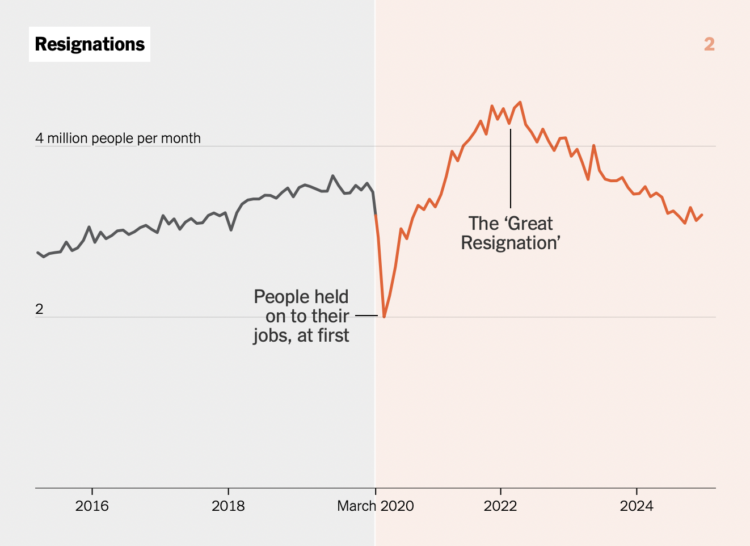
In almost every dataset about life and people that stretches back past March 2020, you can find the blip when Covid changed how we live. Aatish Bhatia and Irineo Cabreros, for NYT’s the Upshot, used a stack of 30 charts to show the shifts.

Each chart shows a pre-Covid gray on the left and a post-Covid red-orange on the right. The lines (or bars) on the post-Covid side extend the past when you scroll. Usually charts that show an empty space to start and then animate the rest are gimmicks, but the extensions highlight the sudden changes in this series.

The scroll style and dimensions are very mobile-first, as the stack plays out in a more familiar way on a phone. The style also makes the 30 charts feel like not too much.

Tags: ,

Read the whole story
Share this story
Delete

2024

1 Comment and 4 Shares
It wasn't originally constitutionally required, but presidents who served two terms have traditionally followed George Washington's example and gotten false teeth.
Read the whole story
Share this story
Delete
1 public comment
alt_text_bot
919 days ago
reply
It wasn't originally constitutionally required, but presidents who served two terms have traditionally followed George Washington's example and gotten false teeth.
Next Page of Stories